
COGS 102C: COGNITIVE DESIGN STUDIO
UCSD Student Hydration
Summary
As part of a team of 6 student designers, we explored hydration culture at UCSD. We were curious how and if students prioritized drinking water. By working with UCSD Housing, Dining, Hospitality (HDH), we were able to collect valuable data and implement a pilot program to make student hydration at UCSD more environmentally sustainable.

Our final design included water towers available at various campus markets and dining halls.
Problem Context
For our project, we chose to focus on the hydration habits of UCSD students, including how much water people drink, what vessels they use to hydrate, how much students prioritize hydration in regards to their wellbeing, and their plastic bottle purchasing habits. We initially focused on the importance of hydration for nutrition and how hydration culture affected the overall health of students, but we were also interested in how sustainable current hydration options on campus are.
Stakeholders
Before beginning our initial research, we identified the stakeholders that we thought were most relevant to the problem we wanted to explore. Those stakeholders were:
-
PRIMARY - Students at UCSD
-
SECONDARY - Housing, Dining, & Hospitality (HDH) Services at UCSD
-
TERTIARY - Beverage vendors, the environment
As the majority of the population at UCSD, and the ones most responsible for water bottle sales at markets, students were the obvious primary stakeholders. This posed a challenge for us, both because of how varied campus experiences are for different students and because we didn't have a recurring group of interview subjects to go back to. Our secondary stakeholders were the people largely responsible for the current options available at UCSD. As the overseeing organization responsible for providing food and beverages to students, stocking on-campus markets, installing and maintaining hydration stations, and executing any health and sustainability decisions, we felt that connecting with HDH would offer us greater resources to promote change at the school.


The Team

For this project, I was the team lead. I initiated contact with stakeholders, planned team meetings, and made sure we were keeping to our deadlines. I also participated in the research, data interpretation, ideation, and testing sessions with the rest of the team.
MY ROLE
Initial User Research
INITIAL RESEARCH
-
Sent out a hydration habits survey sent to classmates and student org members
-
Collected hydration station usage numbers
-
Observed student activity at dining halls and sustainable hydration practices at an external convention
-
Interviewed various individuals, including edge users like student athletes
-
Contacted HDH admin to learn about any current hydration initiatives on campus

EXISTING HYDRATION OPTIONS
-
Hydration stations and water fountains around campus
-
Soda machines in dining halls
-
Personal water bottles, with Hydroflasks and other reusable bottles sold at most campus markets
-
Recyclable plastic water bottles, available at all campus markets and dining halls, as well as brought from off-campus


Hydration stations and Hydroflasks are common ways that students stay hydrated on campus. Hydration stations are located all over campus and each one shows the total usage of that machine in bottles saved and the filter status.
Findings
-
A lot of hydration stations aren’t being used because they are out of the way and hard to find.
-
Despite most of the students we interviewed having reusable bottles, plastic water bottle sales at the on-campus markets haven’t gone down in recent years.
-
People didn’t like cleaning their reusable bottles, and would resort to buying plastic bottles if they had other drinks or fruit in their own bottles.
-
While some students didn’t mind drinking tap water from sinks or hydration stations, others preferred to only drink bottled or filtered water.
We compiled all the data that we collected in an affinity diagram. Some of the subcategories that we included were "hydration station availability", "personal diet habits" and "frustrations of reusable bottles".


Factors to Consider
Through our initial research, we identified a few factors that were important to consider as we continued our research and began ideation. These were topics that often came up in interviews and survey responses, although the different views that students had on them were varied.
-
CONVENIENCE: Many students cited the convenience and availability of plastic water bottles as an important factor in their decision to purchase them. They can be thrown away once they are used up and don’t have to be carried around or cleaned. The inconvenience of having to find hydration stations to fill their reusable bottles deterred some students from carrying them.
-
TASTE: While some students didn’t care about the taste of water, others had a clear preference for the taste of filtered or bottled water over tap. Some people even related taste to the cleanliness or quality of the water, and would only drink bottled water or obviously filtered water.
-
SUSTAINABILITY: Sustainability was a primary goal for our secondary and tertiary stakeholders, and it was important to us that our final design was environmentally sustainable.


To help us compile and visualize our data, we created 6 personas and an identity model. These models allowed us to identify different key users and perspectives that we needed to keep in mind as we continued our work.
Partnership with HDH
After emailing several Housing, Dining, and Hospitality administrators, we finally got a response from Mona Powell who is the Wellness and Engagement Manager. She was already working on a sustainability initiative with the Student Sustainability Council to design a flyer encouraging reusable water bottle usage over purchasing plastic water bottles. We discussed the findings from our research and how we could work with HDH to promote sustainability even more by providing an alternative water source at on-campus markets in place of the water bottles on sale. They were interested in our data because it showed the consumers’ perspective, while their data often focused on sustainability from the provider’s view. She put us in contact with Jonathan Biltucci (Project Planning Analyst) who agreed to help us plan and execute a pilot program testing how the presence of plain and infused water towers would impact water bottle sales.


The infographic that HDH and SSC were working on focused on lessening bottle sales by posting fliers on the fridges that contain water bottles. They believed that educating students on the impact of using plastic bottles would discourage people from buying them.
Changing Focus
NUTRITION TO SUSTAINABILITY
As a result of our partnership with HDH, we decided to shift the focus of our research from nutrition to sustainability. Our research showed that students already had an understanding of the nutritional importance of hydration, but would often prioritize sustainability or convenience over nutrition regarding their hydration habits. We felt that by focusing on sustainability, we would be able to have a more successful partnership with HDH, and therefore be able to make more of an impact with our future design. The data we could collect through the pilot program could make an impact on both our project and HDH’s future sustainability initiatives. As a result, we changed the focus of our future interviews and data collection to be more focused on sustainability rather than the nutritional importance of hydrating.
ROADBLOCKS
-
One challenge with interviewing the student body is that we weren’t able to interview the same people multiple times through our design process. This meant we were simply collecting survey responses or one-time interview responses from individual students and there was no continuity from student feedback.
-
Working with HDH was another challenge we faced because we had to work within their timeframe, and we were limited in the ideas we could prototype because their interest was a big factor in our ability to execute a test. We compromised by organizing a water tower pilot program with them to collect useful data but also continued ideating and prototyping on our own to make sure we didn't focus on any single idea too much.
Water Tower Pilot Program
Over two weeks, we collaborated with Jon Biltucci to finalize plans for our pilot program. We worked to set up a test that was viable for HDH to execute without their workers having to take on a significant additional workload, which required narrowing down locations that had enough space for the towers as well as a filtered water hose that could be used to fill the towers. As a team, we also had to decide how many towers we wanted, whether we wanted regular water or infused with fruit, what flavors we wanted for the infused, and how we wanted to collect data throughout the test.
LOCATION: We decided to put the water towers in an on-campus market as it would increase water accessibility more so than dining halls. At dining halls, there were already soda fountains that were able to dispense cold, filtered water whereas the markets did not have refill options in-house.
GOAL: To find out if students would be more inclined to use reusable water bottles over buying plastic ones if they had an alternative directly available at campus markets. We wanted to know if students would even use the water towers, if they liked them, and if it deterred them from buying plastic bottles.
FACTORS WE CONSIDERED:
-
Number of water towers: 2 or 3
-
Availability of filtered water for filling the tanks
-
Extra workload required for market workers
-
Water type: regular, infused only, or both
-
Length of the pilot program: 1 or 2 weeks
-
How we wanted to collect additional data during the pilot program
FINAL EXECUTION: In the end, we decided to run the pilot program for two weeks. Each week we would have two water towers, with one containing regular water and the other having alternating flavors of infused water. The towers would be located in the Village Market because it was the location that worked best for HDH. Since it wasn't possible for a member of our team to always be at the market to observe and interview users, we decided to collect data through an online survey. A QR code and link were provided on a flyer posted next to the water towers. In addition, we observed the towers several times throughout the week to see how users were interacting with the water towers.


Before we finalized the plans for our pilot program, we went through several versions of how we wanted the water towers to be set up and how we wanted to collect data during the test.
Ideation & Prototyping
IDEAS
While planning our pilot program with HDH, we continued to ideate and prototype other ideas. Since we were already working on setting up the water tower pilot program while going through the ideation process, a lot of our ideas were focused on augmenting the water towers. However we didn't want to limit our ideas, so not all of them were focused on solving the same challenges. Some of the ideas we had included:
-
Offering stickers as an incentive for students using their reusable bottles
-
Selling reusable bottles at different price points to make them accessible to everyone
-
Washing stations, similar to the ones that Starbucks baristas use, where students could rinse their bottles

After ideating on sticky notes, we storyboarded various ideas to visualize how they would help solve the problems that we had identified.
.jpg)
PROTOTYPING STICKERS
The idea that we chose to prototype was using stickers as an incentive for students to use reusable bottles over purchasing plastic bottles. The assumption we were testing: would students be willing to put forth effort in exchange for a free sticker?
We knew that students liked putting stickers on their water bottles, particularly Hydroflasks, both because it was often used as a status symbol amongst the student body and because it allowed them to express their own individuality through the stickers they chose to use. We wanted to know if they would be willing to use their own reusable bottles in place of buying bottles if they were incentivized with a free sticker. Since we couldn’t test this in the time we had, we chose to test our assumption on a smaller scale by offering stickers in exchange for students filling out a survey, to see if they were willing to put in that small amount of effort for a sticker.
.jpg)
.jpg)
.jpg)
.png)
.png)
.jpg)
.jpg)
.png)
First, we rapid-prototyped different sticker ideas by sketching them. Some of our ideas were focused on the environment to get students thinking about the impact of their actions, while others used humor and pop culture. The final sticker design that we chose to make a higher fidelity prototype of was the water droplet emoji (bottom right) because it was simple to produce and directly related to the topic of our project.
Testing
FINDINGS & CONFOUNDS
We encountered several issues with our pilot program, specifically because of the timing and location. Our pilot program took place at the very end of the school year when a lot of students were scrambling to sell or use up the rest of their dining dollars or get more because they ran out. This affected our test in opposite ways, with some students buying more than usual and some less, but it still acted as a confound for the results of our test. The location was also a challenge because it was in a primarily residential area of campus that didn't have any classroom buildings, only residence halls. As a result, the market where the towers were set up had significantly less foot traffic than other markets. Most of the students that came to the Village Market lived in the Village and came to the market to buy specific items, not just to find something to eat or drink between classes. Some of the people we interviewed didn't even bring their belongings to the market, so they didn't have a reusable bottle with which to utilize the water towers. The final issue that we faced was in collecting data. The QR link for the survey was not very salient, and most people that used the towers didn't linger to read the flyer, so we received very few responses.
CHANGES TO THE PILOT PROGRAM
Most of the changes that we made during the second week of the pilot program were to increase the quantity of the data that we were collecting. We continued to conduct in-person interviews and observations, but we also created short paper surveys that we provided with pencils next to the water towers. We also encouraged users to fill out the surveys when team members were at the location. As part of our test regarding the value of stickers as an incentive, we offered stickers to users who filled out a survey. However, people often filled out the survey when asked, even before being offered a sticker as an incentive
Evaluation & Findings
At the beginning of the pilot program, students weren’t aware of the water towers so they would come to the market without their own bottles. Since the location of the market was near residential student housing rather than classrooms, most of the students that came to the market didn’t bring their belongings with them, so they often wouldn’t have a water bottle like commuter students might be carrying with them at other markets. Therefore, they weren’t able to utilize the water towers. In the second week, we interviewed several students who came to the market specifically to fill up their water bottles after becoming aware of the towers. The workers at the market tracked how often they needed to refill the dispensers. We found that they only needed to refill it about once a day because of the size of the dispensers so the water towers didn’t add a significant workload for the market employees.
We conducted validation interviews in two ways, by having students fill out paper surveys while using the water towers and with the HDH admin that helped us set up and run the test. From the student surveys, we found that our water towers were positively received and that many people enjoyed having the option of infused water. Many said that they wanted to see the water towers expanded to other locations, which told us that they enjoyed having the water towers and wanted to see more. In the online survey, one person said: “More locations would be nice!” Several students also mentioned that since the implementation of the water towers, they had stopped buying water bottles and instead came to the market specifically to fill up their reusable bottles. In our validation interview with HDH, we delivered the data that we had collected from the test and received positive feedback from them about the insights we had to give them. Though the final prototype that we were able to get to wasn’t the final design, HDH still valued the data that we were able to give them because it could be used in their future sustainability efforts. They said that they want to move forward with expanding our idea and implementing it as part of their current sustainability initiative.

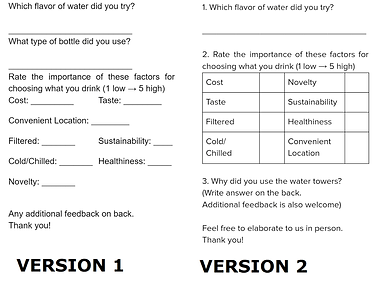

We collected data during the test through observation, interviewing users, and paper surveys.
Final Design
Based on the information we got in our final stage of testing, we came up with a final iteration of our water tower project. Our final proposal involves what a non-pilot version of the program would look like rolled out by HDH. This would be water tower setups in various high traffic market and dining hall areas with three towers: one normal water, two rotating infused flavors. We came to the decision of using the two infused flavors because of the feedback that we recorded suggesting that people would try out different flavors and that different people had different preferences for flavors. The rotating flavors present variety as well as slight gamification to the program, allowing people to prioritize visits for the flavors that they prefer. The full program would be rolled out with the other HDH initiatives such as their infographics that will inform people of the importance of sustainability in order to encourage students to use sustainable sources.
The towers would be located in high traffic places where accessing clean refillable water is difficult and there is access to plastic bottles. Primarily, this would include markets. We also considered certain dining halls such as Ocean View Terrace and Cafe Ventanas because their layouts lend to placement of water towers, and it would be easy for staff to refill and manage the water towers. Also in consideration was the newly rebuilt Canyon Vista or any future built dining halls, as the water towers could be factored into the design.

Reflection & Future Plans
If we had more time, we would have liked to conduct more testing in other locations (markets and dining halls) and collect sales date various times throughout the school year to see if our water towers made a significant difference on water bottle sales. We also would have liked to conduct more testing on incentive systems, whether offering stickers or other items would encourage more students to forego purchasing a plastic bottle in favor of using the water towers. Lastly, we would also like to consider more long term options that wouldn't require manual labor, especially more sustainable options like hydration stations in places with lots of foot traffic so that water towers aren’t the only option. Since this would require plumbing and infrastructure changes, it was outside the scope of feasibility for our project, but was a long term possibility we considered.