
CARMEL CREEK ELEMENTARY SCHOOL
STREAM
LAB
UCSD Global Ties
The Task
WHAT WE WERE TRYING TO DO
Summary
Our team worked with Tiffany Farnsworth, and Carmel Creek Elementary School, to improve their Science, Technology, Engineering, Art and Math (STREAM) Lab. Our challenge was to design a multi-faceted curricula that exposed students to the real-world social, economical, and ecological impacts of the concepts they learn about in the STREAM Lab, so that they can develop a better awareness of local and global communities. Our final solution was an adaptable project framework that taught empathy through a human-centered design lens.

Our final deliverable included a teaching guide with a timeline for the project, resources, and teaching instructions; a slideshow introducing the global problem; and a student workbook with worksheets guiding students through the human-centered design process.
User Research
-
INDIVIDUAL INTERVIEWS: We began our research by conducting individual interviews with Tiffany Farnsworth, the director of the STREAM Lab, and other teachers and administrators at the K-3 school. We learned a lot about the resources available to the Lab, including one-to-one iPads for each student, an AppleTV, a wood cutter, and a wealth of typical arts & crafts supplies. We learned about the current curriculum used for Lab projects, explained the strict class schedule that she had to adhere to, and told us some of the challenges that she had identified in the Lab. We also met with the principal of the school, a kindergarten teacher, and the computer lab teacher to learn more about the school and the STREAM Lab.
-
GROUP INTERVIEWS:One of our biggest challenges during contextual inquiry was understanding the students. As our youngest stakeholders, there were logistical challenges to being able to interview them, but we were able to take turns meeting with groups of three 2nd graders. The interviews with the kids were as informative as they were amusing.
-
OBSERVATION: We spent several days observing the students during their regular STREAM Lab sessions and during additional Lab times throughout the week. We noticed that the students all carried iPads with them, and had various research, videography, and educational apps available to them for any project. A lot of the projects that we observed around the room were similar, and even though the projects they worked on at the Lab were unique, the physical crafts were all "diorama-style".


The STREAM Lab contained a lot of resources, ranging from a Carvey wood cutter and Lego robot-making kits, to white boards, work tables, and craft supplies.
Insights
-
Students enjoy going to the STREAM Lab. They like the freedom they have in the Lab, and like using technology as part of their projects.
-
Tiffany gets to decide the curriculum in the Lab, but it has to adhere to the Next Generation Science Standards in California.
-
A lot of the projects that they did were stretched over several STREAM sessions, which are two weeks apart for each class, so students would often lose focus throughout the project. Tiffany suggested shorter and more discrete activities to maintain interest.
-
The students rarely got to learn about how their curriculum was reflected in the real world. Tiffany wanted them to learn more about the impacts outside of the classroom of the topics they studied in the Lab.
Personas
We started our research by interviewing students and staff members at Carmel Creek, which culminated in our stakeholder analysis matrix. This chart allowed us to identify the stakeholders that we needed to work with closest, and the ones who had the most influence on our team. We decided that the director of the Lab, Ms. Farnsworth, had the most power and interest in our design because she is the one who would be implementing the curriculum. We then used our research to develop two personas.
Sharon
STREAM Teacher
Sharon is the director of the STREAM Lab at a K-3 school in a well-funded school district. She has a diverse teaching background, working with kids of all ability levels and at many schools within the district. This is her first year as STREAM Lab director, and the program is only a few years old. The Lab was well-organized and set up when she inherited the job, but she would like to incorporate a broader worldview into the curriculum.
Sharon
Mark
Student
Mark is a first grader at Carmel Creek Elementary School. He comes from an upper-middle class family and both his parents work full-time. His dad works at Qualcomm and his mom works in management. He is dropped off at school every morning by his mom, who also packs his lunch. His favorite class is the STREAM Lab and the library. When he comes home after school, he likes showing his parents what he worked on, which is available on his online portfolio
Mark
Design Challenge
Our insights and persona development helped us define our 3-part design challenge:
-
Improve the student experience of the STREAM Lab
-
Implement diverse projects
-
Enable students to create community connections and evaluate impact on the community
Ideation


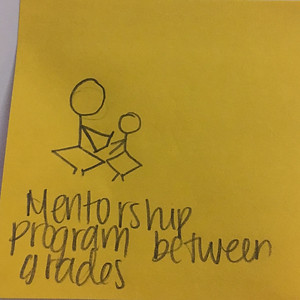


Some of the ideas that we came up with but chose not to pursue included cooking classes that expose the students to different cultures or the science behind cooking, classroom challenges like not using electricity or producing no waste, and a mentorship program between students in different grades.
Prototyping
We chose three ideas to prototype that we thought fit our design problem best:
-
HOUR OF CODE: The first solution that we storyboarded was an Hour of Code, which integrates more coding into the regular STREAM Lab curriculum. We wanted to design a project that would be adaptable, and since there was already a lot of coding curriculum available online, it would be easy to fit into the curriculum already in place. However this project lacked the community connection that we really wanted to encourage with our design.
-
REAL PROFESSIONALS, REAL LESSONS: The second solution we decided to prototype was inviting professionals and academics from UCSD or the greater San Diego area to teach lessons to the students in the Lab. Though we liked that the students could learn about different STEM fields, we decided this project wasn't sustainable for the director of the STREAM Lab, because after we finished our project they would have to cultivate the professional relationships themselves.
-
HUMAN-CENTERED DESIGN FOR KIDS: Our final solution was a project framework that teaches empathy through a human-centered design lens. We liked this idea because it could teach the students about both local and global issues relevant to what they are learning about in the Lab. It was also a project that could be adapted to different grade and skill levels.


We sketched all of our ideas on post-its before choosing the top ones. We created storyboards of our top 3 ideas and got feedback from our stakeholders before deciding which solution we wanted to create and test a high-fidelity prototype of.
We created Capture Grids and a Design Matrix that, combined with feedback from our peers and stakeholders, were used to evaluate and select the design that we wanted to test. We decided on the Human-Centered Design for Kids project as the design solution we wanted to continue prototyping and testing because it was sustainable, easy to use for different grades, adaptable over time, and encouraged the students to think about real-world topics.

Empathize - Define - Ideate - Iterate
Before creating our final prototype, we wanted to test the students' abilities to understand the concepts important for HCD, like empathy, problem definition, ideation and prototyping. Inspired by a guideline we found from IDEAco and Stanford, we created STREAM City and its citizens. Each citizen had a story that described a challenge they were facing, ranging from power outages to poor transportation systems. The 1st and 2nd graders that we tested were grouped in pairs and had to read their assigned citizens' story, then identify what that person was feeling and what societal problem they needed help solving. Once they identified the problem that they wanted to design a solution for, they were challenged to brainstorm ideas and draw them on construction paper. They were also given the chance to prototype their ideas with a variety of craft supplies that we provided.


Through our testing, we learned that we had highly underestimated the students' abilities. They enjoyed the freedom of getting to brainstorm and prototype whatever ideas they wanted, but the citizen backgrounds that we had given them were too limiting and made it harder for the students to come up with solutions. For example, we had a character named Jeremy, who had transportation problems. He didn't have a car, and both biking and public transportation weren't viable options for him. The only idea that the students could come up with was for Jeremy to ask for help. For our final design, we decided more open-ended, real-life problems would make the curriculum better.

Human-Centered Design for Kids: Natural Disasters
Our final design was a framework for a human centered design curriculum that exposes the students to the challenges of different communities around the world, and teaches them empathy and creative problem solving. Not to mention they learn all the steps of the design process. We focused the design for third graders because they are the oldest students at the school and we thought they would be best equipped to learn about a difficult topic. For the initial lesson plan, we chose to focus on post-Hurricane Maria Puerto Rico and the challenges that they have faced. We created a teaching guide, slideshow introducing the topic and student workbook as part of the curriculum.
TEACHING GUIDE
The teaching guide includes an introduction to the topic, structured timeline, materials, resources, and step-by-step instructions for teaching human-centered design.

CLASS SLIDESHOW
The slideshow is meant to be a tool to help teachers explain empathy and the different steps of the design process to students. It gets students thinking about design and the challenges facing Puerto Ricans.


STUDENT WORKBOOK
The student workbook is a collection of worksheets that guides students through empathizing, defining, ideating, prototyping, testing, and peer evaluations.

Reflection
POTENTIAL RISK
Due to the timing of our project coming at the end of the academic school year, we weren't able to implement our design as part of the regular STREAM curriculum. However, we delivered the teaching guide, slideshow and workbook in both physical and digital forms to the director of the Lab to be implemented in their curriculum for the 2018-19 school year. It is possible that parts of the project might be too difficult for the students when they are presented with problems that aren't as curated. Tiffany, or any teacher who might use this curriculum might also have challenges teaching it if they don't have any understanding of human-centered design.
FUTURE CONSIDERATIONS
If we had more time we would have liked to run a pilot program using the curriculum, and potentially expanded to the 7 other schools in the Carmel Creek School System who have similar STREAM Labs. We would have also liked to make multiple versions of the curriculum with different topics for different grade levels.